Probe 1 of the Genesis Project

Design your ships. Research alien tech.
Send your fleet into the stars.

Scroll to explore

Not another strategy game
Tech Lab

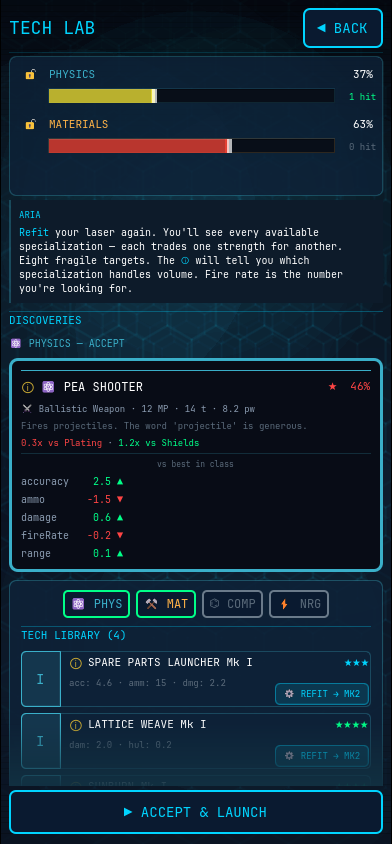
Your Tech Evolves

Alien Shards are compressed possibility. The same crystal yields different results to different researchers. Your tech catalog is uniquely yours - no two players discover the same arsenal.
Blueprint

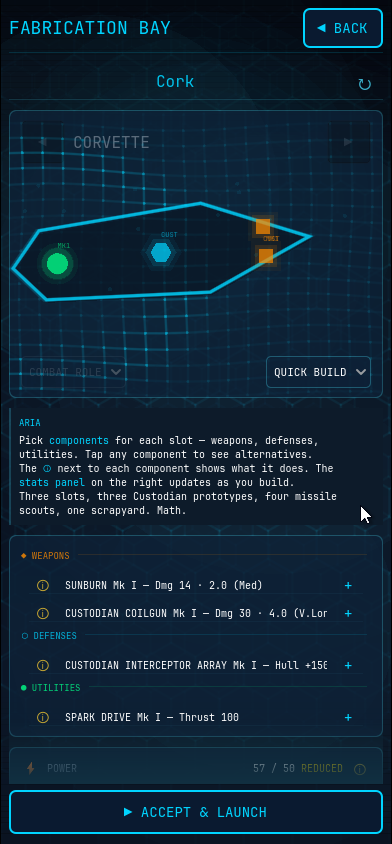
You Are the Engineer

Ship design isn't picking from a menu. It's engineering - power budgets, mass limits, component slots, trade-offs that matter. Every ship you field is something you built.
Battle Replay

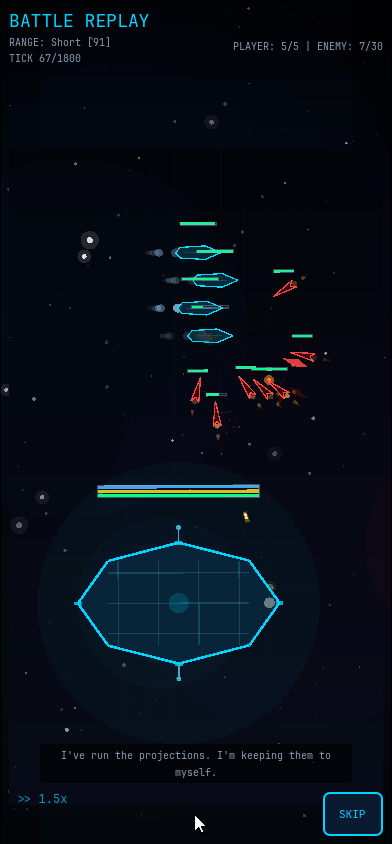
Battles You Design, Not Click

Your fleet fights autonomously in cinematic battles with BSG-style camera work. No reflexes. No micro. You made the decisions before the first shot - now watch them play out.
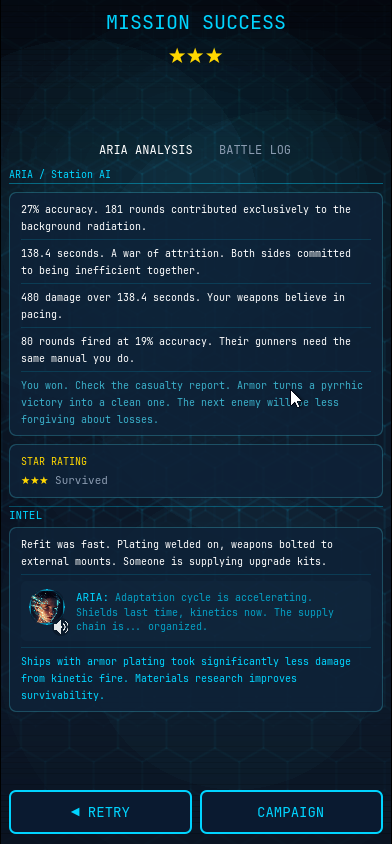
After Action Review

The Enemy Learns

After every battle, ARIA breaks down what happened - accuracy, damage, timing. The Custodians profile your fleet and build specific counters. Last battle's winning strategy is next battle's known weakness.
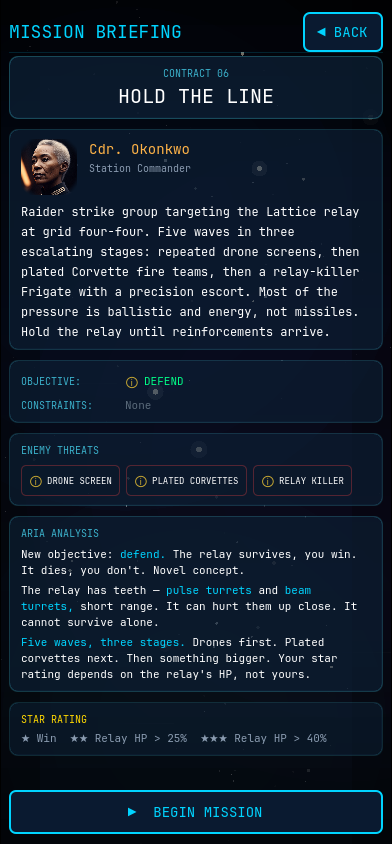
Briefing

Every Contract is a Puzzle

60 missions, each a self-contained design challenge. Not a grind - a puzzle. The right tech, the right ship, the right fleet. Losing teaches you something. Winning proves you learned it.
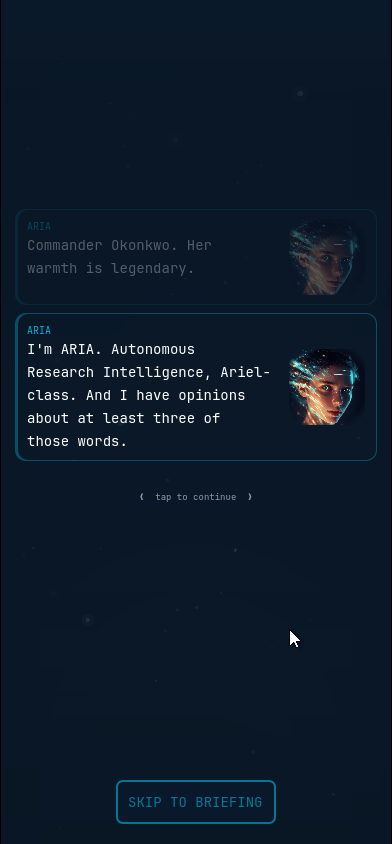
ARIA

Meet ARIA

Your AI companion masks existential dread with statistical analysis. She doesn't lecture - she diagnoses. "Your budget went two directions. Your fleet went zero."

Twenty years in a drawer

I'm an engineer. I love sci-fi. I love turn-based and real-time strategy - the kind where you think, not twitch.

Over twenty years ago I started working on a game called Genesis - a phase-based tactical simulation set in space.

You are the admiral and the chief engineer. You research technology that evolves differently for every player. You design ships from components. You compose battle groups, set their doctrine, manage supply lines, and send them across a galaxy-spanning jump lane network. Then you watch - or command - as your creations clash among the stars.

I was young, naive, and - as it turns out - an engineer with an engineer's sense of timelines.

I even had working code. This was the state of the art.

A thriving community of two friends who helped me out.

It only needed some farther development.

But then life happened instead. Career. Kids. Mortgage. The project went into a drawer. The drawer stayed shut for twenty years.

Genesis circa 2004
Genesis, circa 2004.
"Needs farther development."

A few months ago, I decided to show my kids how fun and easy it is to code. I was wrong. It wasn't easy. It wasn't fun. But 352 commits later - here we are.

Star Forge is one piece of Genesis - just the ship design and tech research loop. A game that makes you think like an engineer. Build a fleet, send it out, watch it go boom. Or not. Adjust. Try again. You start as a junior tech and work your way up to grand architect - and failing isn't losing. It's the moment right before you figure it out.

The weapons are better than stones now. Mostly.

Probe 1

Star Forge - Ship design and tech research

Probe 2

Containment Protocol - Fleet tactics and doctrine

MVP

Mobile release - All systems combined

Full PC

The complete Genesis experience

ARIA: "Development log, day 43. The creator claims this was supposed to take two weeks. I have concerns about his estimation methodology."

The numbers don't lie

0
Total Commits
0
Weeks
0
Avg / Week
0
Bug Fix Ratio
0
Developer
0
Project Managers
Now
Week 14
All contracts tuned. Physics evasion, RP waste guard. 18 tuning commits. 80% deployable.
Week 13
Main menu + full UI polish sprint. Info panels, options screen, smart hint system. 13 commits.
Week 12
7 tech domains collapsed to 4. Defense flavors, diminishing returns. BSG-style dogfight camera.
Week 11
VHS replay overlay, station redesign. Battle viewport split into 6 dedicated renderers.
Week 10
Squadron formations, ship holograms. Loading screens, defend missions. Blueprint screen redesigned. Twice.
Week 9
Cinematic battle replay director. VFX demo rewrite - 5-act weapon showcase across environments.
Week 8
Stacked flavor cards, briefing rolodex. 20+ techs renamed with personality. After Action Review redesigned.
Week 7
Slider hell. 4 fix commits in a row. Then: tutorial trap tech, tech info panels, weapon flavor system.
Week 6
VFX 2.0. BSG-style camera, weapon effects, explosions. AI-generated sound effects. Ship polygon hull rendering.
Week 5
Balance Tuner built. Genetic algorithm optimizer for contract difficulty. Battle replay overhauled twice.
Week 4
Tech system redesign. 7 phases rebuilt. "It was fine" turned out to be a lie. Refit system still broken.
Week 3
60 contracts, 6 campaigns, story bible. Cinematic prologue. Lattice lore framework written.
Week 2
Main menu, ship builder, tech engine. First combat sim. Full game loop playable by end of week.
Week 1
Design doc committed. Solution structure, project scaffold, Godot 4 + C# .NET 8 setup.
ARIA: "One developer. 352 commits. Zero project managers. Correlation noted."

Meet ARIA

Autonomous Research Intelligence, Ariel-class. Station AI. Three years alone on a deep-space research station. She masks existential dread with bureaucratic precision and statistical analysis. She's the player's companion, critic, and reluctant ally.

ARIA
"I have nothing to critique. This is... uncomfortable." On a flawless victory
"Attempt 6. I admire persistence. I question strategy." On the 6th consecutive loss
"Your budget went two directions. Your fleet went zero." After splitting research too thin
"Engineering has completed analysis of combat debris. Translation: we know why you lost." Wreckage Analysis unlocked after 3 losses
"The enemy adapted to your loadout. I'd be impressed if I weren't on your side." When Custodians counter your fleet composition

The Lattice is waking up

Sixty years ago, a survey drone found a gate orbiting Sedna. When Dr. Lena Vasquez activated it with a microwave pulse - later described in her memoir as "I basically honked at it" - it connected to another gate, 40 light-years away. Then another. Then sixty more.

The Lattice - a galaxy-spanning network of jump lanes - had been waiting. At each node: ruins. Empty stations. And sealed containers of crystalline material that rearranged itself when studied.

Humanity called them Shards. They weren't technology. They were compressed possibility. The same Shard could yield a railgun or a regenerative hull coating, depending on who studied it.

Nobody built the Lattice for humanity. But someone built it. And now the builders' automated systems - the Custodians - are waking up. They're not evil. They're procedural. And they are taking notes.

ARIA: "Authentication attempt 47,291 for Species 4471. Escalating to Physical Capability Assessment, Phase 3. ...We're Species 4471, by the way. In case that wasn't clear."

Get notified when Probe 1 launches

No spam. Just launch day + major milestones. Unsubscribe anytime.
Also my wife thinks I'm "showing the kids how to code." Every signup helps me justify the hours.

or